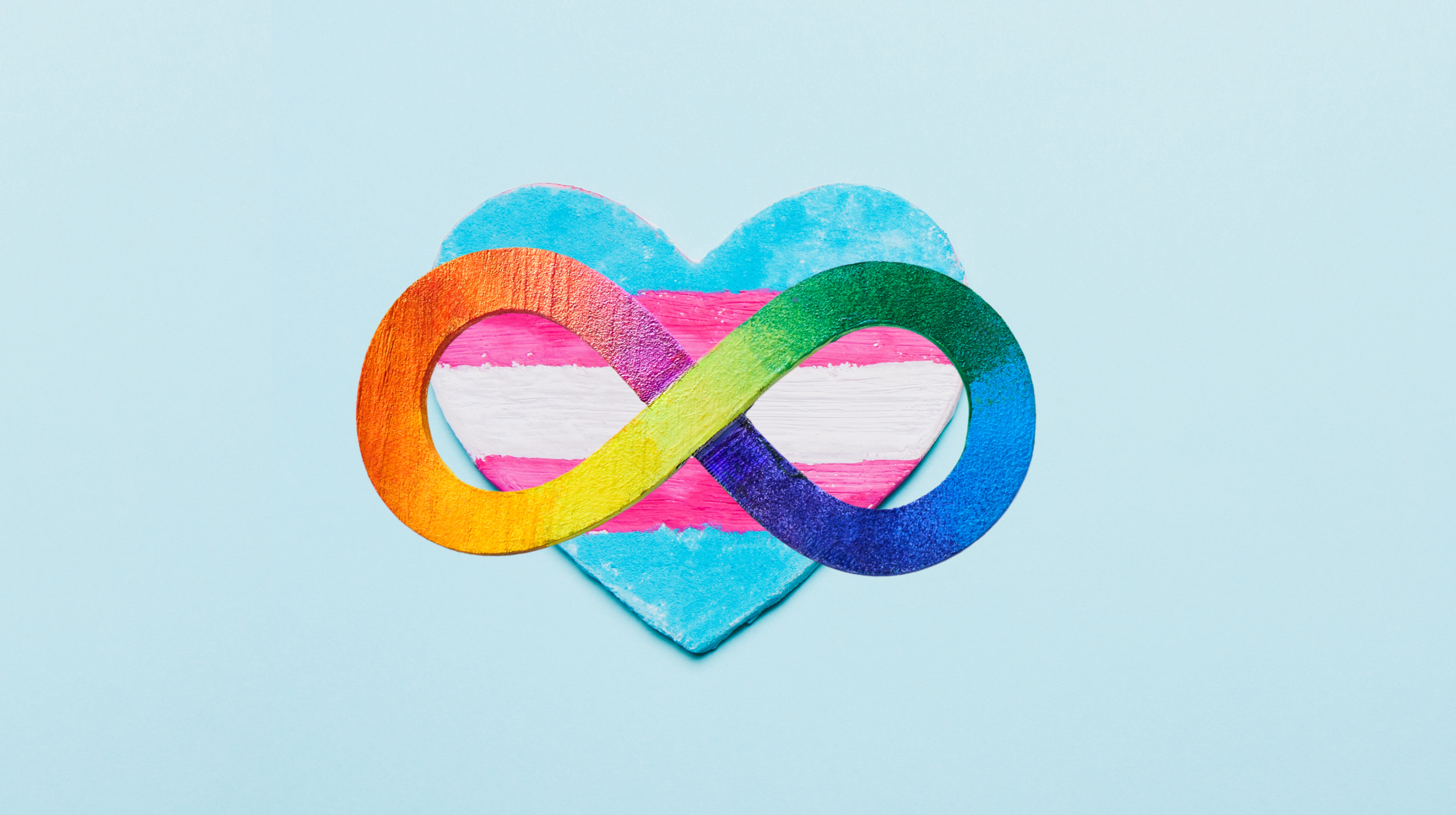
Autistic and Trans: are you both?
GUEST POST: We’re handing the mic over today to Dr. Kade Sharp, PhD, LICSW, CMHS, CST, RPT-S™, and trust us, you’ll want to listen. This guest post brings the kind of insight that makes you pause, nod, and maybe text a friend about it. Thoughtful, a little bold, and very much in our lane.
Growing up, I knew that I was different compared to other kids.
Quirky, weird, eccentric. Quiet, somber, polite. Wise beyond my years. Ahead of my peers. You probably see sentiments like this a lot when you’re reading posts by autistic authors- but I thought my differences were due to my gender and sexuality. Being neurodivergent wasn’t even on my radar.
From a young age, I wondered if I was going to grow up looking like the men in magazines. I was almost five when I copied my dad's shaving and nicked my face with his razor. I always wanted to play as the boy Power Rangers or the androgynous characters. In my writing, my characters fell in love with whoever they loved, regardless of gender. I remember crying over Easter dresses and wondering why I couldn’t be on the boy’s soccer team.
I didn’t know that being transgender was an “option”, so I felt this deep divide from my peers. In middle school and high school, I poured over self-help books, autobiographical stories about celebrities struggling with their mental health, and any media about outcasts or loners that seemed to resonate with me. I wondered what was “wrong” with me and was trying to find ways to fit in, despite how fake I felt from all of the masking. I tried to “find my best self” through things like rocky relationships, perfectionism, and disordered eating.
Queer, trans and non-binary identities made sense.
In my early 20s, I finally accessed support through a therapist and figured out that trans and non-binary people did exist. (It was a different time back in 2010!) Reading, watching, and hearing their stories- even when we were wildly different individuals- felt very relatable and started to answer some questions I’d always had around quirks.
If you’re hiding your authentic self in relation to gender identity or queerness, of course that would feel like masking! And since no one was talking about folks assigned female at birth being autistic- or any type of neurodivergent outside of struggling with anxiety or trauma- this was the only possible explanation for all of my inner experiences. I was clearly trans. And queer.
With this newfound knowledge, I was able to unmask those aspects of myself and slowly lean into becoming more authentically myself. I was inspired to become a therapist, too, and switched my college program from teaching to social work. I started testosterone and gradually changed the clothes, haircuts, and other ways I expressed myself. Things started to feel better in regards to how others perceived me and how I was able to be more authentic.
But I was still different.
I was socially anxious in new groups of colleagues or clients. Evenings were spent decompressing from work and deep-diving into my obscure interests. It was hard to maintain a social life with friends if it wasn’t a regularly scheduled event- and even then, I kept feeling “too peopled out” to go. I’d notice that even the chewing of a family member could make me really irate and I never quite felt happy unless I was engaging in really specific interests or activities.
My clients were different too. Many of their personalities, “quirks”, and thoughts mirrored my own. Very few of them were diagnosed as autistic, but slowly more and more of them received that diagnosis - and eventually I was able to notice it in other clients, too. I started learning more about autism and ADHD so that I could better advocate for them to receive the correct diagnosis and school accommodations.
Even though I was still missing it in myself, I noticed that many of my clients- especially those who were assumed to be female at birth- were getting “missed” by the local diagnostician. I was questioning what I knew about autism and if perhaps I was incorrect about clients, so I reached out to a testing psychologist on the other side of the US to get consultation and see if I was missing the mark.
One of his very first sentences to me changed the course of my life and my understanding of myself:
“Of course your clients are autistic- autistic people *know* each other.”
He assured me that I was correct about the clients I had suspected were autistic and he assumed I was skilled at noticing it because I must be autistic too.
How did I not recognize my own neurotype? This autistic psychologist- my new friend and consultant- was pointing it out within less than thirty minutes of meeting me, but I’d had no idea for my entire life.
How does a trans person not know they’re autistic?
Truly, I think there are many reasons we don’t notice this about ourselves. The most obvious reason is because none of us are taught to look for autism. Even in my graduate program and continuing education courses, this topic was not discussed and we were essentially told to “leave it to the psychologists to work with.”
For trans people who aren’t in the mental health field, it’s unlikely they would be thinking about it at all. Although stigma is slowly decreasing, autistic traits and autistic people still tend to be viewed as stereotypes or caricatures, so accurate day-to-day knowledge of autistic inner experiences isn’t as common. It’s also not very common for medical providers to notice teens and adults who are autistic unless the provider is a specialist or has personal knowledge (like a loved one or themselves being autistic.)
Other reasons might include:
Social differences and masking. When we’re working so hard to either hide our authentic self when it comes to our gender OR we’re trying very hard to have people perceive us as who we truly are, we may inadvertently be changing things that come natural for us to do, say, or think. This may especially be true for trans folks who are concerned about how well they “pass” to others; we are trying to assimilate and fit in on multiple different levels. This is doubly true for trans people of color who may also feel pressured to code-switch in certain environments.
Sensory processing challenges. When you’re wearing a binder or chest plate, it can become tough to know if it’s distressing because it’s additional body pressure or because you’re feeling dysphoric and the sensations are a reminder of that. Even if you’re feeling better with those tools, it’s difficult to parse out if the feeling of relief is from the additional pressure or the decrease in dysphoria. When we know we’re trans or non-binary, it’s easy to assume that all of those feelings are tied to gender dysphoria or euphoria in some way instead of evaluating the sensory side.
Special interests. One of the easiest ways for autistic people to bond with others tends to be through shared passions and interests. When you’re trans or non-binary and are trying to find community, this becomes a strength and tends not to be pathologized. Additionally, if you’re someone with a pretty mainstream interest, people often don’t think twice about why you have that interest and aren’t as likely to suggest autism.
“Stimming.” Is it possible that you’re always tugging at your shirt to conceal your silhouette? Are you copying voices of characters or others because you’re dysphoric about how your voice sounds? Are you repeating words and quotes as your own in order to communicate because you find it more aligned with how you want to present yourself? Or are you doing these things to stim and self-regulate because you’re autistic? It is so tough to decipher what role these things play.
Routines and autonomy. Although autistic people tend to appreciate routine and structure more than their non-autistic (allistic) peers, trans and non-binary folks can often find comfort in this because it allows for more of a sense of control in a world where we’re already marginalized by others. As with most people, we also appreciate a sense of autonomy and control in social situations, our environment, how we express ourselves, etc. It becomes tough to put an autistic lens on this if someone else hasn’t prompted you to think about it from that perspective.
“What if I think I might be autistic and trans?”
I get asked this almost weekly. If I could rewind time, I wish someone had pointed out my traits as potentially being autistic sooner, so that I could have better understood and supported myself earlier in life. If you’re reading this and feeling like you could use more support, understanding, and self-compassion, I would encourage you to take time learning from other trans and non-binary autistic people. Hearing their stories may help you figure this out for yourself. There are also many self-screening tools available to the public, though they have differing levels of accuracy for different populations.
Ultimately, the most efficient way to figure out if you’re autistic is to meet with an autistic mental health professional who provides screenings or evaluations. If you can find a provider who has training in working with trans individuals or is trans or non-binary themselves, that’s even better. This route leaves less work on your plate to find self-screening tools, interpret results, collect data, etc. The mental health provider should be able to support you through self-exploration and formal testing or screening tools. They will also be able to join you for the feelings that often follow figuring out if you’re autistic, so you won’t have to navigate that alone.
I wish you luck on your journey of self-discovery!
Dr. Kade Sharp (he/they) is a queer autistic trans Licensed Independent Clinical Social Worker, Registered Play Therapist-Supervisor, Certified Sex Therapist, and Child Mental Health Specialist practicing in Washington state. He has his PhD in Clinical Sexology through Modern Sex Therapy Institutes. He specializes in supporting queer, trans and non-binary autistic and AuDHD clients of all ages, as well as neurodivergent supervisees. Kade loves helping people figure out they're autistic, playing board & card games, roleplaying, reality TV, true crime, and his 2 adopted senior cats. You can find Kade at Spectrum Counseling and his training platform Curious Cryptid Learning. Kade also co-hosts the Aces Up Your Sleeve Podcast, a podcast to support neurodivergent asexuality-spectrum listeners.

